
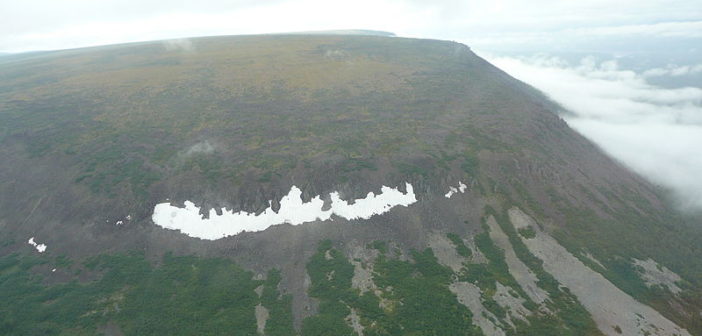

Putorana Plateau is composed of Siberian Traps. Photograph by jxandreani
The Permian-Triassic mass extinction occurred around 252 million years ago and wiped out more than 96% of marine species and 70% of life on land. Multiple theories have tried to explain the cause of this exteinction, including an asteroid impact and massive volcanic eruptions, but better measurements of how long the extinction period lasted is needed to determine a conclusion.
New research from MIT scientists has determined that the Permian-Triassic extinction occurred over 60,000 years, give or take 48,000 years, the blink of an eye from a geological perspective and more than 10 times more quickly than previously thought.
Sam Bowring, the Robert R. Shrock Professor of Earth and Planetary Sciences at MIT, graduate student Seth Burgess and a colleague from the Nanjing Institute of Geology and Paleontology also found that around 10,000 years before the species began to die off, the oceans experienced a “pulse of light carbon”. This pulse reflected a massive amount of carbon dioxide to the atmosphere, raised sea temperatures by up to 10 degrees, and led to increased acidification of the oceans.
The scientists studied the rock formations at Meishan, China to determine the age of the rock formations which offer evidence of the Permian-Triassic extinction. The team analysed the volcanic ash beds, and separated out tiny zircon crystals containing a mix of uranium and lead, and then isolated the uranium. From measuring the ratios of isotopes, they could then determine the age of the rock sample.
But what caused the spike in carbon dioxide? Continued volcanic eruptions from the Siberian Traps may have been a likely cause, and Burgess and Bowring are trying to date the magma flows that caused the steplike hills of the Russian region.
But what originally triggered the spike in carbon dioxide? The leading theory among geologists and paleontologists has to do with widespread, long-lasting volcanic eruptions from the Siberian Traps, a region of Russia whose steplike hills are a result of repeated eruptions of magma. To determine whether eruptions from the Siberian Traps triggered a massive increase in oceanic carbon dioxide, Burgess and Bowring are using similar dating techniques to establish a timescale for the Permian period’s volcanic eruptions that are estimated to have covered over five million cubic kilometers.