
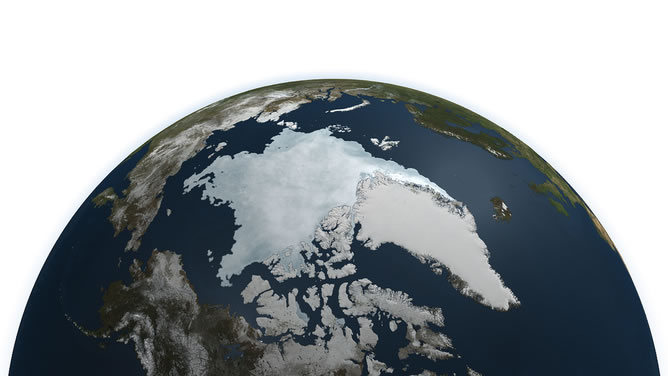

Arctic sea ice reached record lows in 2011. Arguing that this is meaningless because sea ice has been low before is an example of non sequitur – it does not follow. Image by NASA Goddard Space Flight Centre
As the Arctic ice melts into the ocean, the Arctic is darkening and absorbing more radiation, amplifying the effects of global warming according to new research.
In a study published in the Proceedings of the National Academy of Sciences, Ian Eisenman, a climate scientist at the Scripps Institution of Oceanography in California, and his team used satellite radiation budget measurements along with satellite microwave sea ice data to document the Arctic-wide decrease in planetary albedo, or reflective coefficient, and its amplifying effect on climate change.
They found that over a 33-year period between 1979 and 2011, the Arctic planetary albedo decreased from 0.52 to 0.48, meaning that an additional 6.4 W/m2 of solar energy has absorbed into the Arctic ocean over that period. When these figures are averaged over the globe, the impact of this Arctic darkening had an impact on global warming about 25% as large as that caused by CO2 emissions, which governments around the world are only now finally starting to target.