
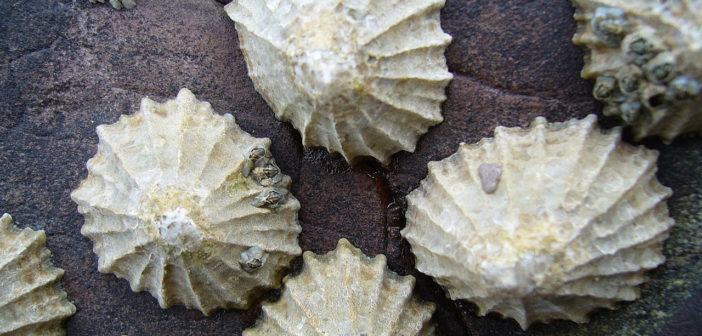

Scientists have found the the material that make up limpet teeth is the strongest natural material ever discovered, and could provide bioinspiration for materials used in everything from Formula 1 racing cars to aeroplanes.
The research, published in the Royal Society’s journal Interface, found that the teeth of aquatic snails, commons to beaches around the world, are made of a material stronger than spider silk, previously thought to be the strongest natural material.
Researchers from the University of Portsmouth examined the small-scale mechanical behaviour of teeth from limpets using atomic force microscopy, a method used to pull apart materials all the way down to the level of the atom.
The scientists found that the teeth contain a hard mineral known as goethite, which forms in the limpet as it grows to help it climb over rock surfaces and remove algae for feeding.
The fibres of goethite are just the right size to make up a resilient composite structure, and in contrast to most materials limpit teeth are the same strength no matter their size.
Professor Asa Barber, lead author of the study, said:
“Nature is a wonderful source of inspiration for structures that have excellent mechanical properties. All the things we observe around us, such as trees, the shells of sea creatures and the limpet teeth studied in this work, have evolved to be effective at what they do.
“Until now we thought that spider silk was the strongest biological material because of its super-strength and potential applications in everything from bullet-proof vests to computer electronics but now we have discovered that limpet teeth exhibit a strength that is potentially higher.”