
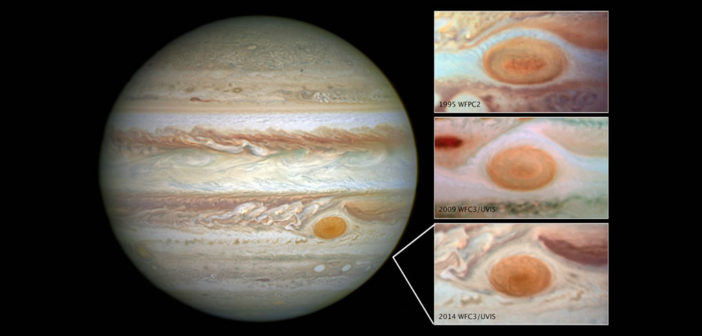
Jupiter’s Great Red Spot (GRS), the persistent anticyclonic storm, 22° south of Jupiter’s equator, is shrinking, according to Nasa scientists.
Astronomers using the Hubble Space Telescope have calculated that the storm is shrinking by 580 miles per year, with the spot currently 10,250 miles across.
In the 1800s, the oval-shaped GRS was 25,500 miles on its long axis, declining to 14,500 miles across when the Voyager 1 and 2 space probes flew past in 1979, and then to 13,020 miles across in a 1995 Hubble image. Then in 2012, amateur observations showed the spot to be shrinking at an ever faster rate, and changing its shape from an oval to a circle.
Amy Simon of NASA’s Goddard Space Flight Center in Greenbelt, Maryland, said:
“In our new observations it is apparent very small eddies are feeding into the storm. We hypothesized these may be responsible for the accelerated change by altering the internal dynamics and energy of the Great Red Spot.”