
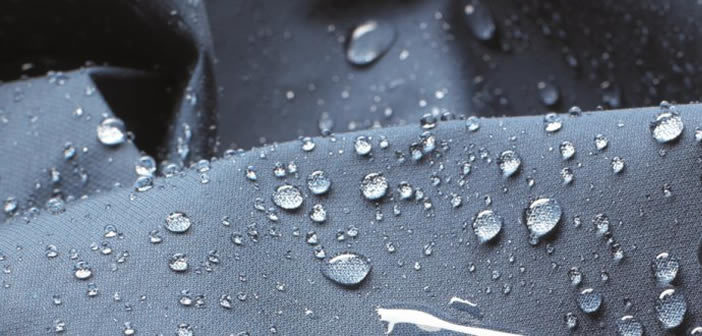
Most people will have come across Gore-Tex as the breathable fabric used in boots and jackets that lets water vapour out and stops rain water from getting in, but the material also has other applications in the medical field such in sutures and synthetic knee ligaments.
The material, also known as expanded polytetrafluoroethylene (ePTFE), was first developed in 1969 by Wilbert L. Gore and his son, Robert W. Gore in somewhat of a happy accident. Rather than slowly stretching polytetrafluoroethylene (also known as PTFE or “Teflon”), the pair applied a sudden tug of pressure and managed to expand the PTFE by 800%, creating a micro porous structure that was about 70% air with 1.4 billion pores per square centimetre.
Gore-Tex is not just waterproof, but hydrophobic as the difference in surface energy between water and PTFE creates a strong surface tension and causes water to bead-up into droplets larger than the micro pores in the membrane. This surface energy is maintained by a durable water repellent (DWR) finish on the surface of the jacket.
The fact that as much as 70% of the material is made up of air, also makes Gore-Tex useful as an lightweight insulating layer for a jacket, with the outer, membrane and inner bonded together into one flexible material
The breathability and insulation properties of the fabric makes it ideal for use in clothing where the wearer wants to keep out the elements but also let out their perspiration. As such, the fabric is used by brands from outdoor company The North Face to workwear firm Engelbert-Strauss
The porous nature of Gore-Tex also makes it ideal for various medical applications, because it is nearly inert inside the body and permits the body’s own tissue to grow through the material, integrating grafted material into the circulation system. As such, it is now used in the medical field in a variety of products ranging from sutures, to vascular grafts, and synthetic knee ligaments.
Since the expiration of the main Gore-Tex patent, which was approved back in 1970, a number of other competing technologies, both cheaper and more expensive, have come to market with similar properties. While each variation, and the various Gore-Tex materials, vary in the number of layers and how they are bonded, each is making use of the same properties that has made Gore-Tex such a success since it first came to the market in 1978.