
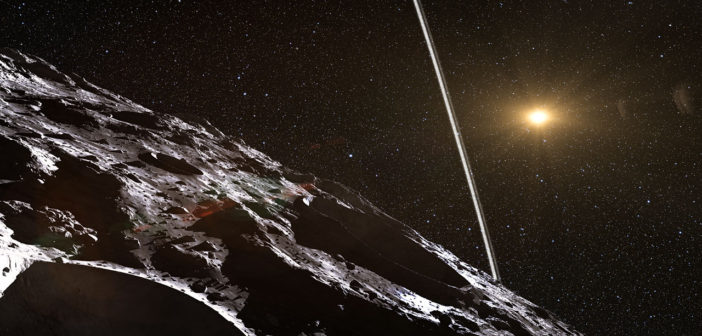
When schoolchildren conjure up an image of Saturn, it is the rings that make it stand out, but Jupiter, Uranus, and Neptune have also been observed to be surrounded by rings. New observations of a distant asteroid orbiting beyond Saturn, however, have shown that this too is surrounded by two fine, dense rings.
Astronomers led by Felipe Braga-Ribas were expecting to see an occultation, as asteroid (10199) Chariklo passed in front of the star and blocked its light, but what surprised the scientists was that there were short dips in the star’s brightness just before and just after the occulation, implying that the asteroid was surrounded by rings,according to the European Southern Observatory (ESO).
Analysing of the data from seven different telesopes including the 1.54-metre Danish and TRAPPIST telescopes at ESO’s La Silla Observatory in Chile, the scientists were able to discern the size and shape of the asteroid, as well as the shape, width, and orientation of the rings.
They found that the 250km diameter asteroid was surrounded by two rings that were seven and three kilometres wide, with nine kilometres separating them.
Why the asteroid is surrounded by rings is currently a mystery, although astronomers believe that they were likely formed from debris after a collision, with the clearly defined gap caused by the presence of a small moon-like satellite, as Ribas said:
“As well as the rings, it’s likely that Chariklo has at least one small moon still waiting to be discovered
The astronomers have published their findings in the journal Nature.