
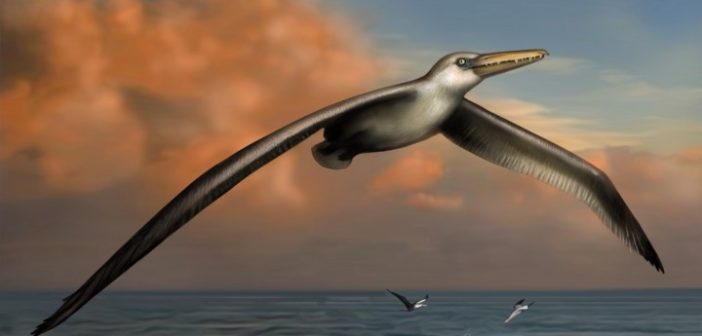
Scientists have discovered the fossilized remains of an extinct giant bird, which is believed to have been the largest ever to take to the skies.
Pelagornis sandersi was a masterful flyer and glider with a wingspan of up to 7.4m, twice as large as that of the current largest bird, and lived 25 – 28 million years ago.
Describing the birds, Dr Daniel Ksepka, the newest Curator of Science at the Bruce Museum in Greenwich, said:
“Pelagornithids were like creatures out of a fantasy novel – there is simply nothing like them around today”
Scientists thought that the upper limit for a bird’s wingspan to take flight is around 5m, as the power required to flap the wings becomes greater than their muscles can provide, but Pelagornis sandersi appears to contradict that theory. However, instead of continually flapping their wings, Ksepka proposed that the giant species could harvest energy from the environment, taking advantage of ocean winds, to spend much of their time in air gliding.
The fossil was originally discovered by Charleston Museum volunteer James Malcom in 1983, when excavations began for a new terminal at the Charleston International Airport in South Carolina. The specimen was well preserved and archaeologists identified it as a new species of Pelagornithidae, an extinct group of giant seabirds, due to the “bony tooth-like spikes” in the jaw.
A paper by Ksepka discussing the find was published in the journal Proceedings of the National Academy of Sciences.