
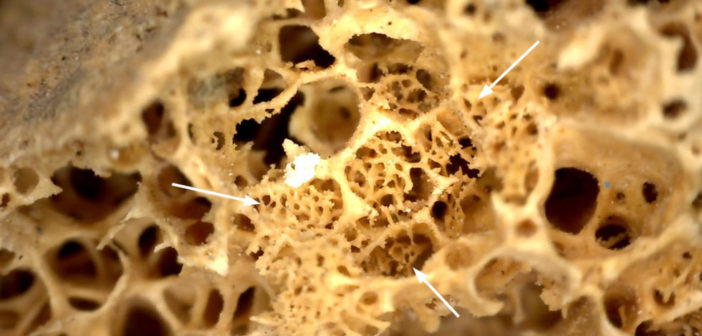


Image showing new bone formation in the iliac crest. Image by Michaela Binder et al/PLoS ONE
A skeleton discovered in an ancient tomb in the Nile Valley in Sudan has been found to show signs of metastatic cancer.
Researchers from Durham University and the British Museum analysed the bones of a young male, aged between 25 and 35, believed to have lived around 1200 BC, with their research published in the journal PLoS ONE.
Using radiographic, microscopic and scanning electron microscopic (SEM) imaging, the scientists found evidence in the bones of a tumour that had spread across large areas of the body. This made it the oldest discoveries of evidence of a metastatic carcinoma to date, and “provides further support for the claim that cancer is a disease of considerable antiquity” according to the study.
They hope that information gleaned from this discovery at Amara West will help them understand the causes of cancer in ancient humans and provide evidence of how cancer has evolved over the last 3,200 years, as lead author Michaela Binder says in the report:
“Very little is known about the antiquity, epidemiology and evolution of cancer in past human populations”