

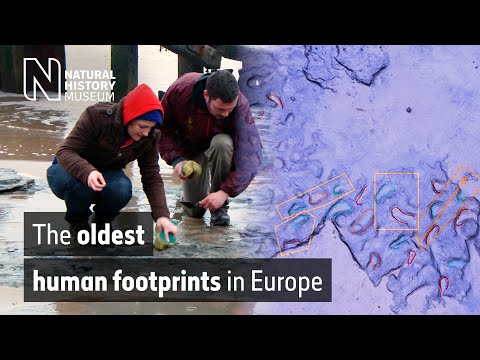
A storm last May uncovered a cluster of footprints on a north Norfolk beach that are believed to be the oldest human tracks found outside of Africa, dating back an estimated 800,000 years.
The group of muddy footprints, thought to have been left by a group of five people, possibly a family, were found on the beach at Happisburgh and provides evidence of the earliest known humans in northern Europe. Previous discoveries of stone tools and animal bones implied a population on British soil, but this is the first time scientists have been able to observe direct evidence.
Dr Nick Ashton of the British Museum, who made the discovery, said:
Although we have no human bones, the most likely species was Homo antecessor or ‘Pioneer Man’, who lived in southern Europe at this time. They were smaller-brained than ourselves, but walked upright and fully bipedal.
We actually know very little else about the people who left these prints, but from the plant and animal remains at Happisburgh we know that they were able to survive winters colder than today.
“At first we weren’t sure what we were seeing,” said Dr Nick Ashton of the British Museum, who made the discovery. “But as we removed the remaining sand and sponged off the seawater it was clear the hollows resembled prints.”
The prints were probably left by to the only human species found in Europe at the time: a robust, but tall and fully upright person called Homo antecessor or “pioneer Man.”
“These people were of similar height to ourselves and fully bi-pedal,” said Professor Chris Stringer a palaeoanthropologist at London’s Natural History Museum. They are thought to have become extinct as a species 600,000 years ago.
– See more at: http://blogs.channel4.com/tom-clarke-on-science/oldest-human-footprint-discovered-norfolk-beach/695?#sthash.UfUIHJP3.dpuf