
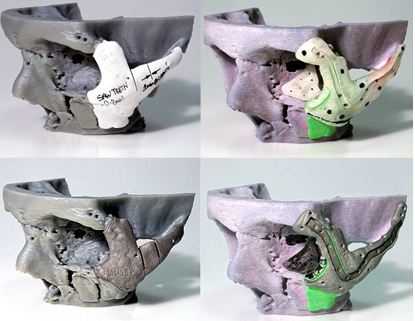
3D printed cheekbone and eye socket models and implants. Image courtesy of NHS Wales
Surgeons in Wales have used 3D printing to help reconstruct a man’s face after a horrific motorcycle crash.
Stephen Power, 29, was in a motorbike accident in September 2012, which left him with two broken arms, a right leg so badly damaged that it required a bone graft, fractures to his skulls, and both cheeckbones, both eye sockets, and his upper jaw broken.
Surgeons treating Power at Morriston Hospital were able to repair most of his facial injuries, but because he had damaged his left eye, ophthalmologists told surgeons to leave the area to avoid damaging his sight any further.
His sight has mostly recovered, but because the surgeons go near his left eye, his left cheekbone was left out of place, and the bones around his left eye socket did not heal correctly, making his eye appear sunken and dropped.
To correct his left cheekbone and eye socket, the team turned to 3D printing technology from the Centre for Applied Reconstructive Technologies in Surgery (CARTIS), a partnership between Morriston Hospital’s Maxillofacial Unit and the National Centre for Product Design and Development Research (PDR) at Cardiff Metropolitan University.
The team scanned images of Power’s face to design guides to cut and position the bones and holding plates, with all the models, guides, and titanium implants produced by 3D printing.
The team used scanned 3D images of Stephen’s face to design guides to cut and position the bones, as well as plates to hold the bones in place. All the models – along with the finished guides and medical-grade titanium implants – were produced by 3D printing.