
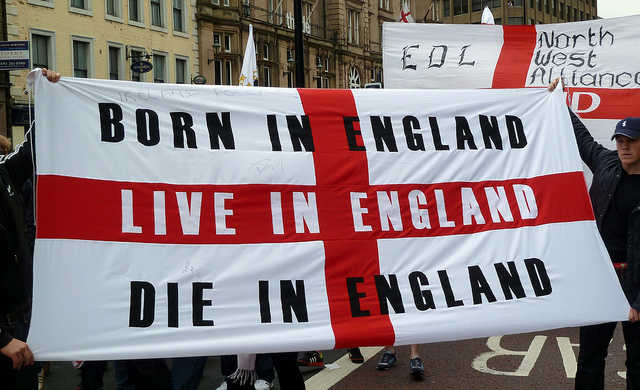

EDL banner from a 2010 rally. Photograph by Gavin Lynn
Last Tuesday two of the most prominent figures of the English Defence League (EDL), stepped down from their positions. Tommy Robinson and Kevin Carroll stated that they could not control the “extremist elements” of the EDL, thus were forced to terminate their involvement.
Robinson, although it wasn’t always apparent, claimed that he and the EDL were opposed to “militant Islam” not Islam in general. However, the EDL largely relies on social media to communicate with its supporters. There is no formal vetting procedure of supporters, which has lead to it becoming a platform for a variety of individuals with differing views. A report by Demos (2011) gathered information from 1,295 of the EDL online supporters. It found that EDL support is made up of a varied group people with ranging levels of ‘extremist’ views.
With diverse mix of supporters and the departure of its key figureheads, what does the future hold for the EDL? One Facebook supporter stated, “I feel the EDL is going to crumble after Robison and Carroll left”. There is a danger that the EDL could crumble, however there is also a far scarier prospect, that the EDL shifts towards a more extremist agenda and modus operandi.
With Robinson and Carroll’s departure there is a chance that other ‘moderate’ figures within the movement could leave too, thus marking a further shift towards a more extremist agenda. With one supporter commenting on the Facebok page, “I’m very tempted to leave if this is becoming the face of EDL now. I oppose ALL extremism”. This shift could be further exacerbated if Robinson forms a new organisation, which would offer an arena for the more moderate EDL supporters in which to operate.
Another point worth considering is that, with Robinson gone there is no longer a unifying figure for the movement, someone to communicate the message to the followers and perhaps more importantly with the external world. So, with no figurehead and no-one engaging in dialogue with the external world there is a high probability that the movement’s regional subgroups could solidify and internalise.
Consequently, the EDL could mutate into multiple groups with varying ideologies. These smaller more clandestine sub-groups or ‘cells’ could potentially provide a fertile ground for more radical elements to dominate.
Written by Aimee Rose Gentry