
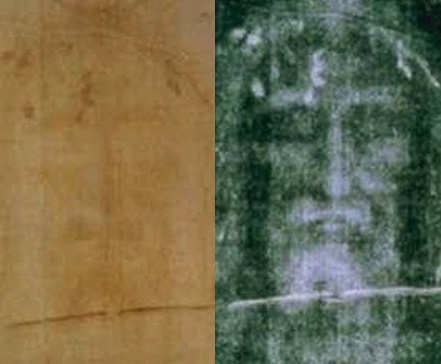


Researchers believe that the X-ray-like image on the famous Shroud of Turin could have been caused by neutron radiation from an earthquake in 33AD, which may have also resulted in an incorrect carbon-dating of the cloth in 1988.
In an article published in Springer’s journal Meccanica, researchers led by Alberto Carpinteri of the Politecnico di Torino in Italy say that an earthquake in Old Jerusalem soon after Jesus died, a date believed to be around 33AD, could have created the shroud that proponents maintain shows an image of Jesus after crucifixion.
After years of promoting the shroud as one of the most important Christian relics, carbon dating performed on a segment of the cloth in 1988, dated it to around 1260, more than a millennium after the death of Jesus.
Now Carpinteri’s team are claiming that high frequency pressure waves created in the Earth’s crust during an earthquake could cause the release of neutrons that could have caused inconsistencies in the original carbon dating process. In their study, they propose that an earthquake measuring 8.2 on the Richter scale in Old Jerusalem in 33AD could have released neutrons that caused the shroud’s famous image. Moreover, the neutrons released could have also interacted with nitrogen nuclei to cause increased the level of carbon-14 isotopes found on the linen fibres that could have confused the 1988 radiocarbon dating tests.