
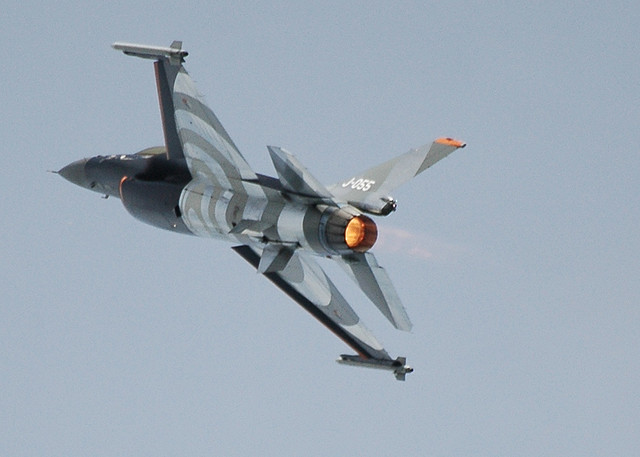

F16 Fighter Jet as used by the IDF. Photograph by Peter Mulligan
Israeli military aircraft have attacked a target close to the Syria-Lebanon border in an apparent attempt to stop the Assad regime from sending stockpiles of weapons to the militant group Hezbollah.
Two people are reported to have been killed and five injured in the air strike, with the Syrian state media claiming that the target was a “research facility”. Diplomatic and security sources, however, describe the target as a “convoy of trucks”, whilst the Israeli Defence Force (IDF) have given no comment.
Lebanese media described a number of Israeli fighter jets flying over Lebanese airspace between Tuesday afternoon and Wednesday morning.
Israel has publicly warned on a number of occasions that it would take military action in Syria if it believed that the chemical weapons stockpiles in Syria could fall into the hands of Israeli enemies Hezbollah or “global jihadists”. Israeli intelligence is continually monitoring the movement of military equipment in Syria via satellite for possible chemical weapon shipments.
It is believed that Hezbollah has stockpiles of conventional weapons within Syria with the Assad regime known to supply the groups with money and arms. Hezbollah leader Hassan Nazrallah now describes moving these weapons to Lebanon as a matter of urgency in order to keep them under Hezbollah control.
Israel’s concern over the situation in Syria has risen in recent months as the once stable Assad regime comes ever closer to falling, and the possibility of Syria becoming an Islamist state right on Israel’s border emerges. How Syria will develop politicly after the fall of Assad is still a major unknown within intelligence and security circles, with the opposition forces increasingly divided between the moderate and distributed Free Syrian Army (FSA) and a number of hardline Islamist groups such as the Nusra Front.
The Israeli air strike on Syrian territory has provoked the Russian government to express concern, with the foreign ministry saying in a statement:
“If this information is confirmed, then we are dealing with unprovoked attacks on targets on the territory of a sovereign country, which blatantly violates the UN charter and is unacceptable, no matter the motives to justify it”
Russia has refused to denounce Syrian President Bashar al-Assad during the 22-month civil war, and is rumoured to have continued to supply the regime with arms. Some sources described the truck convoy that was targeted by the Israeli air strike may have been containing advanced Russian-made anti-aircraft missiles, which would have given Hezbollah greater military power if involved in a conflict with Israel, with the Israeli air force one of its greatest assets.