
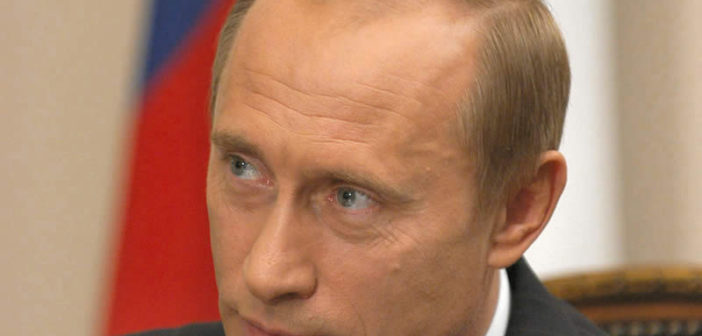


Russian President Vladimir Putin. Photograph courtesy of the Kremlin
From opposing shale gas exploration to defending US whistle-blower Edward Snowden, Russian President Vladimir Putin and his PR machine have been forging an unlikely alliance with Western protest voices.
The scene was improbable to say the least. On July 12th, 2013, Tanya Lokshina, Deputy Director for Human Rights Watch Russia and long-time critic of Putin’s Russia, found herself in a press conference at Moscow’s Sheremetyevo Airport listening to American refugee Edward Snowden read a carefully written press statement to a crowd of journalists and human rights activists. After harshly critiquing the US government, busy vigorously employing every tool in its diplomatic arsenal to bring Snowden back to American territory, the former Booz Allen contractor praised Russia as “the first country to stand against human rights violations by the powerful rather than the powerless”.
The conference turned into an impressive PR event for President Putin, as many of the very activists who spend their days criticizing his United Russia administration found themselves listening to an American fugitive praising the Kremlin for its human rights record. Snowden was accompanied by Olga Kostina, probably the only individual who runsboth a human rights organization called ‘Resistance’ (Soprotivlenie in Russian) and is in charge of PR for the secret police, the FSB (formerly known as the KGB). Olga Konstina’s husband, Konstantin Kostin, is a renowned political strategist, largely credited with bringing Putin into office in 2000 and 2004, and his presence largely seems to confirm the picture of Snowden’s conference as an international press op for the Russian regime.
Putin the environmentalist
One can question how important a positive image in the West really is for the Kremlin, but the fact is that they try very hard to win over certain sections of North America and Western Europe. Russia Today (RT), a multi-lingual state-funded news site and television network, very successfully follows and incorporates trends in the Western media and blogosphere, cleverly injecting the views of the Kremlin along the way. Anti-fracking protests staged by environmental groups in the West, for example, received considerable coverage on RT’s English site. Putin himself voiced concern over the “huge” environmental risks of shale production at a press conference on April 25th, 2013.
While it may seem strange that Putin, who presides over the world’s biggest petro-state, would come out as a die-hard environmentalist, one must remember that Russia’s state-owned giant Gazprom, which supplies around 25% Europe’s gas and accounted for 70% of Russian exports in 2012 (up from 50% in the mid-1990s), has everything to lose from the United States and other countries exploiting their shale gas reserves, especially its former Soviet vassals in Eastern Europe.
For example, it is difficult to think of a country that has been more dependent on Russia than its western neighbour Ukraine. In 2009, after a dispute over prices, the Russian government cut off all gas transfers going to Ukraine, temporarily leaving much of Europe dry. The dispute ended with Ukrainian Vice-President Yulia Tymoshenko pledging her country to a 10-year contract with Ukraine paying above-market rates for an amount of gas that exceeds actual needs.
Now, Ukrainian President Viktor Yanukovych has given the green light to the signing of a $10 billion deal with Royal Dutch Shell to exploit his country’s shale gas reserves and is using this newfound source of energy independence to extricate itself from Russia’s orbit. This November, Yanukovych will sign an Association Agreement with the European Union, a defiant move against Russia. What is impressive, though, is how the Kremlin has managed to reframe its own geopolitical interests as universal principles widely shared by a liberal Western audience.
The enemy of my enemy…
‘Question more’ is the omnipresent slogan of RT’s English site, perfectly directing its content to a large swathe of online denizens unwilling to swallow the conventional wisdom broadcast by ‘mainstream’ Western media outlets. Hit conspiracy films, such as the ‘Zeitgeist’ series, have keenly displayed the lack of trust in official news sources on both sides of the Atlantic. In 2012, RT broadcasted a 12-episode series entitled ‘World Tomorrow’, where Wikileaks founder and editor Julian Assange conducted a series of political interviews with both international protest figures, such as leaders of the Occupy movement in London and New York, and established critics of the United States, such as Ecuadorian President Rafael Correa.
The irony of The Julian Assange Show is the same as that of Edward Snowden’s Moscow press conference. While Assange has continually committed himself to protecting individual freedoms and “fighting state oppression”, he has found himself allying with Putin’s Russia, a country that ranks 148th out of 179 countries in the 2013 World Press Freedom Index, below countries such as the Democratic Republic of Congo. On an ideological scale from individual freedom to state control, Putin and Assange would seem to be on opposite ends, yet have engaged in a strategic alliance of sorts. The enemy of my enemy is my friend, as the old saying goes.
While the Kremlin seems to have found an effective way of tapping into the discontent of many Westerners with their own governments, it is unclear to what extent a news outlet such as RT can cover up the chasm that exists between the values of many liberal Western readers and United Russia partisans. Throughout the on-going wave of bad press Putin has been receiving for his party’s controversial ‘gay propaganda law’, for example, RT has alternated between construing the law as an invention of the Western media/governments and as a legitimate law enjoying widespread support in Russia. It seems doubtful, though, that such strategies will succeed in winning over Western audiences. At the end of the day, readers would do well to follow RT’s motto for any news site from any region in the world and ‘question more’, but especially if it comes from someone like this.