
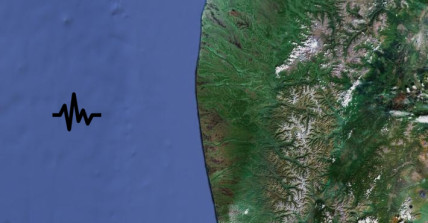
Earthquake at Sea of Okhotsk, Russia.
Image courtesy of Google Maps/TerraMetrics
Tremors were reported 7,000 km away in Moscow after a powerful 8.3 Richter scale earthquake hit Russia’s far east, with its epicentre in the Sea of Okhotsk, north of Japan.
The quake is reported to have originated 600 km under the sea bed, with the epicentre to be in the seismically active region of the Kuril-Kamchatka arc according to the US Geological Survey.
Tremors could be felt for around five minutes by residents of nearby Petropavlovsk-Kamchatsky on the Kamchatka peninsula, with people evacuating buildings as far away as Moscow, and strong tremors experienced across Siberia.
Tsunami warnings were issued by emergency services across the far east for Sakhalin and the Kuril Islands, but these were soon lifted as the threat subsided.
In a summary of the tectonic events, the US Geological Survey said:
The May 24, 2013 Mw 8.3 earthquake beneath the Sea of Okhotsk, Russia, occurred as a result of normal faulting at a depth of approximately 600 km. At the latitude of this earthquake, the Pacific and North America plates are converging at a rate of approximately 78 mm/yr in a west-northwest – east-southeast direction, resulting in the subduction of the Pacific plate beneath Eurasia at the Kuril-Kamchatka trench. Note that some authors divide this region into several microplates that together define the relative motions between the larger Pacific, North America and Eurasia plates; these include the Okhotsk and Amur microplates that are respectively part of North America and Eurasia. The depth and faulting mechanism of the May 24 earthquake indicate that it ruptured a fault deep within the subducting Pacific lithosphere rather than on the shallow thrust interface between the two plates.
This deep section of the Pacific slab beneath the Sea of Okhotsk has hosted several large earthquakes in the past – four above M 6 within 200 km of the May 24 event since 1988. These included a M 7.7 earthquake in July 2008, 115 km to the southwest at a depth of 630 km, and a M 7.3 event in November of the same year, 95 km to the southeast at a depth of 490 km. Because of their great depths, none are known to have caused damage. Intermediate-depth (70-300 km) and deep-focus (depth > 300 km) earthquakes are distinguished from shallow earthquakes (0-70 km) by the nature of their tectonic setting, and are in general less hazardous than their shallow counterparts, though they may be felt at great distances from their epicenters. The Pacific slab in the region of the May 24 2013 earthquake is seismically active to depths of over 650 km.