
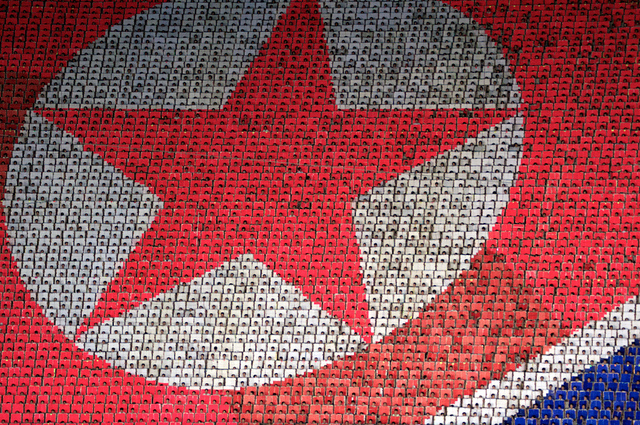

Photograph by Joseph Ferris III
Whenever somebody at home learns you have been living in South Korea for quite some time they immediately, and understandably all ask the same question – ‘What about North Korea?’.
It is a reasonable query–the disputes on the Korean Peninsula have always found ample attention from the world’s press. Anyone with memory of major news stories over the past 12 months will remember last year’s coverage of the North’s almost daily apocalyptic tirades against South Korea, the USA and pretty much anyone else who took their fancy. Couple this with the North’s nuclear bomb test and you had the makings of a media storm. Family and friends would urge me and my fellow expats to consider coming home, the prospects of their loved ones being caught up in a nuclear war was not exactly what they had in mind when they encouraged us to go out and explore the world.
But I’ve always found that I have the same response for the people who queried me about North Korea as I do for those who passionately plead for me to return home – “Don’t worry about the North, they won’t do anything.”
To many at home this seemed like naivety, an almost idealism that the worst wouldn’t happen here, that my decisions to stay were born out of some misplaced morality that something like nuclear war couldn’t happen. It’s an understandable reaction to a rather uninspiring reassurance.
But for those of us who live in South Korea our relationship with the situation in the North is immeasurably different to that of the outside world. I stand by my comment that the North won’t do anything, but would qualify it by adding that they could do something given the right circumstances.
The situation in the South doesn’t reflect the hysteria in the press and the subsequent alarm of the rest of the world. In a 24 hour hour news cycle and an increasingly competitive print press North Korea are masters of political theater routinely employing such words as ‘merciless’, ‘final destruction’ and ‘ruthless’ to describe the war they’ll unleash and in the process securing the sensationalist angle the world’s press crave. The North is portrayed as an unpredictable and dangerous regime who shouldn’t be trifled with. This is true – but misleading.
To describe something as unpredictable and dangerous implies a lack of self control. When one looks at the internal structure of North Korean society a lack of control is hardly the first assessment one would make. Communist countries have been well known for their obsession with order, and North Korea is no different. The control they exercise over their 25 million citizenry would make Stalin himself proud. So to portray the North as unpredictable and dangerous in the erratic sense is clumsy and oversimplified.
The unpredictability and dangerousness of the North Koreans lies precisely in their obsession with order. Nothing a country like the North does is random or by chance. There is always an aim or a reasoning behind their actions. Whether the pressure they want felt is internal (a power struggle between the political and military factions within the country) or external (a grab for aid or renegotiations of sanctions) isn’t always clear. But in a country that is capable of horrendous atrocities against those who threaten the order of the regime, the danger of escalation is greatly increased if they don’t get exactly what they want.
The media circus that the North is able to inspire through their inflammatory outbursts are reassuring for those of us living in the South. The North are able to force the reaction that will usually lead to their eventual appeasement and the press is allowed to revel in one of the last great villains of the Cold War. The status quo is uneasy, but it’s holding.
In periods of turmoil on the Korean Peninsula the reaction of those of us living in South Korea is interesting. There are none of the hallmark signs of a country that is seriously considering its safety. There is no mass exodus from the country – by either South Koreans or expats; the army reserves are occasionally but on alert, but are seldom called to rejoin the ranks of the regular army; there is no run on the currency inside South Korea, even if the international markets react negatively. At the very least one would expect a threatened people to panic buy and stock up on essentials – but none of this happens.
South Koreans are able to look past the hysteria of the international and their national press and give the situation more context. North Korea may be threatening the apocalypse, or at the very least total war – but these threats hold little weight when all reports suggest there are no missile movements in the North, no large scale military equipment or personnel movements – nothing unusual at all. Dropping a nuclear bomb on your neighbors without preparing for a war that would surely follow would be, at best, bad military planning and worst very stupid. To the people living in the South it is indications like these that we measure the threat level. Listening to the threats made by the North Korean news agency, although terrifying, are hardly an indicator of truth or intent. This is a news agency that last year unequivocally stated that unicorns do exist – they make great news stories, but are hardly a reliable source of information.
But for all the talk of North Korea’s aggression towards the South and its allies, the South must bare some of the burden for the North’s confrontational posturing. They are not passive victims of the North’s. Private South Korean citizens routinely fly balloons filled with propaganda into the North’s territories encouraging the people to rise up against its government and join the free world. The leaflets are filled with pictures and stories of the luxuries the South enjoy. Although this may seem like a small infraction on the North’s sovereignty, we must see this through the eyes of the North. The North exercises a huge influence over its people, they control all the information people receive and even tells the people how to interpret it. The power the regime have over the hearts and minds of its people is key to its survival. Threatening this control through genuine information or misinformation strikes at the very heart of the control mechanisms the Government has in place. Even though it is private citizens that fund and man such activities, the North complain that the South do little to stop it and even encourages such practices – it’s probably a fair criticism.
And then we come to the war games staged by the South Korean and American militaries every year. The South and the USA claim these drills are defensive exercise aimed at repelling any military conflicts the North may start. While the North considers them a practice run for an eventual invasion. No matter which analysis is accurate, one can imagine how the North must feel having the world’s most powerful army and a country with which it is still technically at war with flying bomber jets over its land and a navy of war ships a mere miles away from its territorial waters firing off live rounds. The options open to the North to let the world know they are alarmed and feel threatened by such drills are limited, but they find ever more destabilizing methods to let us all know – probably the most dramatic of these was the bombing of Yeonpyeong Island in 2010, killing 2 civilians.
But despite all the agitation on the Korean Peninsula there is never the feeling war is going to break out. Things can feel tense and its natural to contemplate the worst. South Koreans often reassure the expat community that there isn’t anything to worry about, much the same way we reassure our family and friends there is nothing to worry about. It seems that there is a bigger threat that the South Koreans are worried about than a war with the North, and that is that the North Korean Government does eventually collapse. South Korea is a developed country that has all the trappings of the West – if the regime in the North finally folds the prospect of reunification becomes very real. The South isn’t confident that it can absorb the 25 million impoverished people of the North into its economy without ruining its own. In so far as the risk the North pose the South, war isn’t the one worrying the people.