


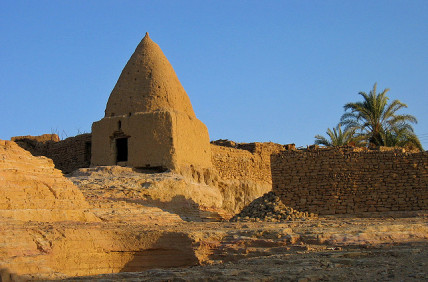
Baharia Oasis, Egyptian Sahara. Photograph by nailjs
Herodotus called Egypt ‘the gift of the Nile’ and today almost all of Egypt’s estimated 82 million people live along the route of the Nile and the coast of the Mediterranean: Cairo and Alexandria are home to the vast majority of the population, and Cairo one of the most densely populated cities on earth. This leaves a vast and often overlooked periphery – the Egyptian desert, stretching from the White Desert in the west of the country to the great shifting form of the Sahara to the limestone desert of Sinai in the east, where Egypt borders Israel.
This vast periphery was also noticeably absent from the great story of Egypt’s recent history: the overthrow of Mubarak by popular dissent in 2011. Egypt’s Arab Spring was fundamentally urban, both a product of crippling levels of urban unemployment, particularly youth unemployment, and the space the city opened up, with the help of social media, for protesters to coordinate and mobilise in major cities as they did in the days leading up to Mubarak’s fall. If the Egypt of colonial lenses was a T E Lawrence vision of uncharted deserts, the dominant image of contemporary Egypt is the crowded urban arena – the demands and desires of Tahrir Square.
But the Arab Spring is playing out in dynamic ways in Egypt’s varied peripheries too, as the new realities of the post-Mubarak era continue to unfold. The Sahara is now a space in which different visions of the nation are projected and manifest, although the voices and concerns of the Sahara cannot make themselves heard as easily as those in the country’s urban centre. The centre-Sahara dynamic of the Mubarak era is being both inherited and transformed in light of the post-revolutionary realities, playing themselves out in particular in the following relationships: the changing nature of unrest in Sinai, the crisis of confidence in al-Qaeda triggered by the Arab Spring combined with new spaces for Islamism in the country’s periphery during the volatile post-revolutionary period, and how the post-revolutionary institutions are dealing with Mubarak-era legacies and projects in the Sahara, most notably the immense planned City of Toshka.
The Sinai in the east, the most densely populated and volatile part of Egypt’s periphery, has borne the brunt of the instability of the post-revolutionary power-contestations. Under Mubarak’s long reign, the Bedouin tribes of the Sinai were subject to concerted policies of marginalisation, from harassment to legal barriers to owning their own land, to economic exclusion. The very word ‘Bedouin’ became a kind of exoticised ‘Other’ in Egyptian national discourses from Nasser onwards, building upon colonial constructions of the image of Bedouins to juxtapose them to the ideals of the modern Egyptian. The penninsula’s position as geopolitical pawn to the conflicting interests of Israel and Egypt (Egypt ‘regained’ the peninsula through the Camp David Peace Accords) has led to both its appropriation and neglect by the Egyptian state. The established and growing tourism industry in the region, centred around Sharm el-Sheikh, is rarely sustainable and has frequently further marginalised Bedouin communities through uneven development.
With the authoritarian state keen to turn the area into a ‘security state’ as a buffer to Israel and the Rafah crossing to Gaza, the Bedouin of the Sinai may not have been central to the Arab Spring protests that overthrew Mubarak but they certainly had few reasons to mourn the departure of the Mubarak regime. In the period since the fall of the dictator, however, the situation in the Sinai has not calmed; rather, the power vacuum and legacy of exclusion from the centre have combined in problematic ways.
The kidnapping of twenty five Chinese workers in North Sinai in January and two American women in February signal the fracturing of social order – the kidnappers aimed to pressure the Egyptian government to release Bedouin detained in central prisons after earlier skirmishes. While the overthrow of the Mubarak regime provided an opportunity for Sinai to heal from the neglect and abuse it suffered under the decades of authoritarianism, the turmoil of the period since the revolution has often worsened the situation in the region, with both further economic downturn and a rise in social violence.
Its geographical proximity to Israel and the Rafah crossing also makes north Sinai a locus of smuggling activity, and an attractive terrain for Jihadist groups to organise where the state is weakest. While the Arab Spring undoubtedly triggered a deep internal crisis in al-Qaeda’s positioning in the Arab world, the liminal spaces and ruptures in social and political order triggered by the revolutions and uprisings of 2011 have given the organisation new opportunities of alliances with dissatisfied groups and new terrain on which to operate, as in the case of the al-Qaeda sub-group Al-Qaeda in the Magreb, who have been forging alliances with local terrorist groups, to some degree of success in the case of Mali and more tentatively in Egypt. Jihadists have capitalised on the longstanding social exclusion of the Bedouin from the national centre, for instance cooperating on attacks on the Egypt-Israel gas pipeline after the revolution, although the Jihadi-Bedouin dynamic is as tense as the Bedouin-Egyptian-state relationship, as Islamists create problems for the residents of the region through their actions, not least attacks on Egyptian troops and the reprisals these provoke on Bedouin communities.
This problematic triangulation between Bedouin, Islamists capitalising on the chaos of the post-revolutionary transition and the Egyptian state has culminated in events in October 2012 whereby the Egyptian state was reported to be ‘considering’ arming the Sinai Bedouin, as Bedouin leaders have urged the government to allow them to arm themselves in the absence of state security in the region, and the increasing presence of Islamic militants. Such an initiative has a precedent in Nasser’s creation of the Bedouin ‘National Guard’ military force in the Sinai in the 1950s, which helped patrol the Israeli border and mediated between the Egyptian military and local tribesmen, although after this was abandoned Israeli attempts to strategically ‘win over’ Bedouin, positioning them as ‘Children of Israel’ in an attempt to stake a claim in the Sinai, contributed to growing mutual suspicion between the Bedouin and the Egyptian military. If some kind of arming of the Sinai Bedouin by the Egyptian state were to take place, it is unlikely to diffuse the Islamist activity in the region so much as exacerbate tensions, particularly if no concerted effort is made to address the long-term social exclusion and discrimination of the Bedouin by the Egyptian state. In the meantime, reports that arms from Libya have made their way to the region are hardly encouraging.
Another proposed strategy by the post-revolutionary Egyptian state is to stabilise Sinai through developing agriculture and the resettlement of Egyptians from outside the region into proposed housing projects across the Sinai penninsula. The plan, announced in the summer of 2012, includes the cultivation of 200,000 acres in central Sinai, the mountainous region that is particularly underdeveloped, and economic incentives for those considering relocating to Sinai. Positioned as an pressing development strategy of national security, the Sinai development project would certainly help Egypt’s failing agriculture, which urgently needs addressing – in 2009 Egypt was the world’s largest importer of wheat, and unsustainable food prices were one of the triggers of the unrest that led to the overthrow of Mubarak. However, even aside from the practical problems, the question remains of whether such an initiative would not further marginalise Bedouin, as tourism has frequently done.
The Sinai may be Egypt’s tinderbox desert, a fractured peninsula of contested claims, socially excluded communities, security outposts and clawing dissent, but to the west the rest of the desert unfolds – the great main body of the Sahara, making up the overwhelming majority of Egypt’s territory. Geologically much of this is the great Nubian Sandstone System, the world’s largest fossil water aquifer system; Sahara historian Eamonn Gearon has described these aquifers as underground lakes that lie beneath the Sahara, though “instead of being recognisable, uniform bodies of water can more accurately be thought of as subterranean regions of saturated stone.” Navigating these aquifers would be key to any agricultural development of the Sahara, and extensive construction work began during the Mubarak era that the new government has inherited as a mixed blessing.
This main body of Egypt’s Sahara is less populated than the Sinai region, although groups such as the Beja communities have significant populations in the Red Sea Hills of the south east and the Kharga Oasis. The most major project the post-revolutionary system has inherited from the Mubarak era was the astounding and improbable ‘Toshka Scheme’, a project so ambitious it was often referred to as ‘Mubarak’s Pyramid’, a testament to delusional, Pharonic ambition. Toshka began in 1997 as a government plan to relocate 20% of Egypt’s population from cities to the desert, particularly the region of the Nile valley. It consisted of building a system of canals from Lake Nasser to the Western Desert, where cities would be constructed, though by the time Mubarak’s regime fell the only achievement was the diversion of water from Lake Nasser to part-way up one canal. The high saline levels in the desert make irrigation exceptionally difficult while funding the project was a continual challenge throughout the Mubarak era, and a report from The National last year on the ‘New City of Toshka’ fifteen years on notes that only 10% — 21,000 – of the estimated hectares of farmland have been created, while aerial photographs reveal many of the farms to be abandoned.
If the Mubarak regime had not fallen, it is difficult to imagine that the Toshka Scheme would ever have materialised – the idea that millions of Egyptians would relocate to the desert by 2020 seemed implausible even without the corruption and setbacks that marred the project. There were concerns throughout the Mubarak era that the project would exacerbate regional tensions with Sudan, as Toshka would have used more than the share of Nile water allocated to it by regional treaties. Louisa Loveluck has recently analysed in openDemocracy the legacy of the resistance to relocation by Bedouin and other groups to the El Dabaa nuclear development project from 1981 onwards, which points to the likely resistance the Toshka project would also have met if it had continued on track under the Mubarak regime.
The post-revolutionary forces now face the question of what to do with the remnants of the project: the Muslim Brotherhood’s Freedom and Justice Party announced early on that they opposed continuing the project along the plans of the Mubarak era, while in 2011 Prime Minister Essam Sharaf negotiated with the companies who signed what are now considered illegal land deals for the Toshka Project during the Mubarak Presidency. An argument has been growing that the government should focus instead on sustainable desert tourism rather than desert reclamation projects and desert relocation projects – but the negative impact of tourism on local communities in the Sinai suggests that this could easily further marginalise Saharan inhabitants. And for all the hubris of Mubarak’s over-ambitious and ill-conceived Toshka Project, the fact remains that it was an attempt to address a problem that Egypt continues to face – the lack of development in agriculture and sustainability in this area is a pressing concern for the new government, not least on the logic that the cost of imports and the intolerably high price of food for the Egyptian population was one of the underlying triggers of the dissatisfaction that culminated in the events of 2011. In a country that is 95% desert, the prospect of food self-sufficiency will always likely entail some attempt at cultivating the Sahara.
On top of the concerns of security in Sinai and the question of the future of the Toshka project and Sahara reclamation, the new political realities of the post-Mubarak nation layer over the specific concerns of the communities of the Sahara. The fragile development of Egypt’s democracy reconfigures the relationship between the Sahara and the state centre. Gallup polls from 2011-2012 found rural Egyptians to be actively engaged in the emergent democratic processes – voter turnout was at 72% in rural areas compared to 79% in urban areas, according to Gallup analysis of parliamentary elections between November 2011 and January 2012. The strong initial support for the Muslim Brotherhood’s Freedom and Justice Party and the Salafi Al-Nour Party in rural areas seems in large part based on constructions of political identities in opposition to the corruption and decadence of the Mubarak era under which rural communities were marginalised, although according to some reports Bedouins in western Egypt this year turned from their earlier support of Islamist parties in the parliamentary elections, instead supporting Mubarak-era Prime Minister Ahmed Shafik in the Presidential election run-off rather than the Morsi, an indication that, while Bedouin communities may still be reeling from marginalisation and discrimination under the Mubarak era, the tensions between Islamists and Bedouin figures also remains potent.
The main, pressing tasks ahead of Egypt in the wake of the Presidential elections will have profound effects on the Sahara’s population, communities, economy and political organisations. In particular, the task of drafting a legitimate, democratic constitution – currently in a tangled review process in Cairo following last year’s controversial approval by referendum – will determine many features of future Sahara-state relations. The heritage of authoritarianism and the elevated role of the military in Egypt’s previous constitutions and experience under Nasser, Sadat and Mubarak is in danger of being perpetuated by the new constitution, re-establishing a dynamic that would certainly further alienate Sinai.
The disputed role of Islam in the constitution that dominated much of the public discourse through the constitution-drafting process has the potential to now feed into the Bedouin-Islamist-Egyptian-state triangle. While the argument was made through the constitutional crisis of December 2012 that bringing Islam into the fold of the constitution and state apparatus would diffuse political Islam as an oppositional force, the further alienation generated by the mishandling of the constitutional drafting process and constitutional referendum has fed instability rather than diffusing oppositional forces, both in Sinai and throughout the region . Similarly, the structure of the state itself as imagined in the 2012 constitution – the amount of control given to the central government apparatus versus how much power is decentralised, for instance – will also impact significantly on the future nature of desert political life, particularly in the fraught power relations of Sinai. Aside from reviewing the new constitution and processing the crisis it initiated in December, Egypt also has to deal with the legacy of a state riddled with corruption and further pummelled by the chaos of the revolutionary period. Focusing on economic growth in the Sinai could do much to quell the tensions that have been mounting since the revolutionary period, but while the economic recovery is framed to such a large extent in terms of IMF conditionality there has been little opportunity to explore this path.
With Mubarak gone, the Sahara has a chance at a fresh start, an opportunity for Egypt to foster and heal the rifts and neglects of its vast periphery. The question is whether the legacies of marginalisation on the part of the Sahara, and the temptation to revert to modes of authoritarianism and central control by the state, can be bridged by the deepening of the democratic process. Morsi’s political miscalculations surrounding the constitutional crisis and the ongoing impact of economic instability further complicate any attempt to bring stability to the desert, particularly the fractious Sinai The question is whether the political will can be found to diffuse the tensions and develop the region before its accumulated frustrations explode into Egypt’s fragile post-revolutionary order.
Written by Heather McRobie
Heather McRobie is a PhD candidate at Oxford University, where she studies transitional justice in the Arab spring. She has written for publications such as the Guardian, the New Statesman, and the Globe and Mail. She is a Commissioning Editor on openDemocracy.
This article was originally published in Italian for Limes magazine.