
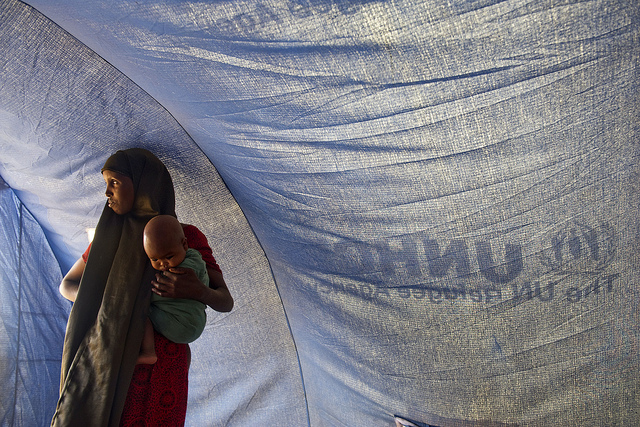

A Somali refugee stands inside a tent with her baby in Dollo Ado, Ethiopia. Photograph courtesy of the UN
Today is World Refugee Day and as of 2012, there are about 45 million refugees in the world. The campaign Welcome to my Country pretends to raise awareness of the situation of these people.
“Welcome to the country which has no flags and does not appear in maps, a country where tourists do not arrive. You do not need a passport or a visa to live there; you only need to have lost it all.”
This is the introduction to the fantastic documentary presented by the UNHCR in Spain in collaboration with director Fernando León de Aranoa and actress Elena Anaya, coinciding with World Refugee Day. The 25 minute documentary recounts the visit to the Ethiopian refugee camps of Dollo Ado and Assosa in 2012, where thousands of Sudanese and Somalie refugees live.
The documentary perfectly reflects the way the refugee camps are organized, the conditions the refugees face daily and the way in which they communicate with their families in their countries of origin. Simultaneously, the UNHCR has created the websitewww.welcometomycountry.es to increase the awareness of the situation of refugees, where one can take a look at the conditions of an imaginary country of which about 45 million people (approximately the same population as Spain) are part of.
The conflicts in Syria, Mali, Sudan and DRC forced more than one million refugees to flee their countries to safer places and about 6,5 million people became Internally Displaced (IDP’s). According to the Global Tendencies Report of the UNHCR even though the number of conflicts decreased in 2012, there are more IDP’s and refugees today than any other time since 1999, currently, every 4,1 seconds there is a new refugee or IDP in the world.
Today, the 20th of June is World Refugee Day and it is a day to think about the situation of the invisible victims of conflicts and the victims of political, social, ethnic and religious hatred. It is a day to think about those who flee their homes to survive. People like Kebane, a Libian refugee now living in Spain who expressed her will to start her life over: “I don’t want to live out of charity; I want to be integrated and to do something useful for the Spanish society that has allowed me to live here”. We must recover empathy, overcome stigma and raise awareness.
Most of the conflicts from which these victims had to leave are already forgotten, but have been ongoing for years, even decades. The only way in which one can help them is trying not to forget; to keep on being interested in what it is happening inside their borders, so that governments do not forget either.
One must remember that refugees are forcibly displaced people that leave their countries due to the fear of being persecuted. They are extremely vulnerable and rely completely on the help of others, namely host countries. Let’s celebrate their national day. Welcome to their country.
Today is World Refugee Day and besides a decrease in the number of existing conflicts in the World as of 2012, there are about 45 million refugees in the world. The campaign Welcome to my Country pretends to raise awareness of the situation of these people.
For more information see: The Global Trends Report 2012: Displacement. The New 21st Century Challenge
Written by Júlia Turon i Lorén