
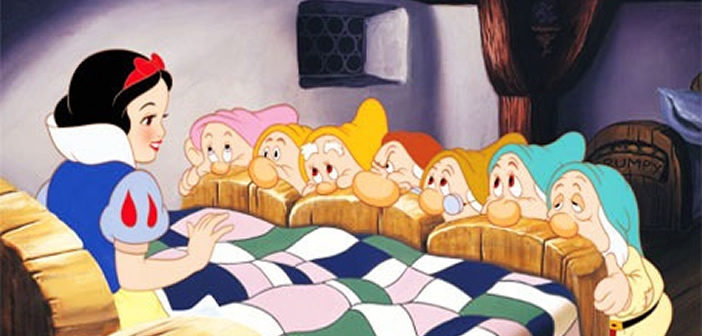
Seventy five years ago on December 21st, 1937, a momentous event took place for the filmmaker Walt Disney. It saw the premier of a film which would go on to form the foundation of his global empire, and cast its spell on film animation and the dreams and fantasies of countless children and adults for generations to come.
Until this point in the history of film, a medium still relatively in its infancy, animation had been largely considered of limited interest, producing cartoons for children or short films of cinematic whimsy for family audiences. Even Disney – widely acknowledged to be at the forefront of the field – had never ventured further than extended shorts such as his wildly successful Silly Symphonies. It was generally believed that no-one, child or adult, would have the patience to sit through a feature length cartoon film. However Snow White and the Seven Dwarfs (1937) changed all that. Though many, including Walt’s own wife Lillian and brother Roy, thought that he was mad to embark on such a project, the eventual success and influence of the film would prove the nay-sayers wrong.
In the years since its release the facts, including the following seven, surrounding Disney’s masterpiece have become almost as legendary as the film itself.
1) Scene But Not Heard
A number of scenes were planned for the film but never got into the final cut. These included:
- The queen holding the prince in a dungeon and using her magic to make skeletons dance for his amusement.
- A fantasy sequence accompanying the song ‘Some Day My Prince Will Come’ in which Snow White imagines herself dancing with her prince in the clouds beneath a sea of stars.
- The Dwarfs building Snow White a bed with help from the woodland creatures
- The song “Music in Your Soup” where the dwarfs sing about the soup that Snow White has just made them.
- A musical number, ‘You’re Never Too Old to Be Young’, featuring the dwarfs. It was pre-recorded, but never animated.
2) Snow White’s Voice

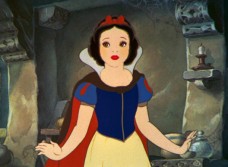
Snow White
3) The Kiss Of Death
It may have taken a kiss from her prince to awaken Snow White from her apple induced slumber at the conclusion of the story, but the role was more like the ‘kiss of death’ for the career of poor Adriana Caselotti who had set her heart on becoming an opera singer. Uncle Walt proved he was’t so ‘wonderful‘ when he had it written into her contract that she would not appear in any other films or on stage, saying “…that voice can’t be used anywhere. I don’t want to spoil the illusion of Snow White.” Adriana’s only other film role was two years later with an uncredited voice over in The Wizard of Oz (1939). During the Tin Man’s song ‘If I Only Had a Voice’ it is Adriana who sings the words “Wherefore art thou Romeo?” Some feat to have appeared in two of cinema’s most famous films yet never actually be seen!
4) A Princely Sum

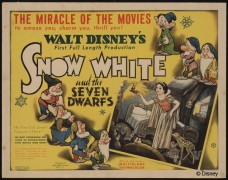
Snow White poster
5) The Fairest One of All
Upon its general release in February 1938 Snow White and the Seven Dwarfs became not only the top grossing film that year but also the most successful film ever made up to that point, a record it held until it was knocked off its perch the following year by Gone With the Wind (1939). Despite this, the film which was dubbed ‘Disney’s Folly’ during its production, has gone on to become through re-releases in the cinema, on video and now DVD, the most watched film in history. It’s success at the time of its initial release gave Disney the financial wherewithal (it made over $8,000,000, the equivalent of $132,085,110 today) and encouragement to continue making animated features. Future classics such as Pinochio (1940), Bambi (1942) and Alice in Wonderland (1951) have made Disney the name that will always be synonymous with the art of film animation.
6) Golden Girl

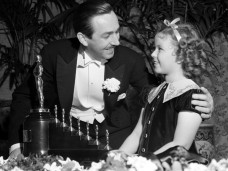
Walt Disney and Shirley Temple
7) No Fairytale Ending
Though Snow White and the Seven Dwarfs may be amongst Disney’s most successful films it has not always struck an harmonious chord with everyone. The influential film critic Roger Ebert of the Chicago Sun-Times, has been quoted as saying that Snow White is a “bit of a bore” and that “Disney’s inspiration was not in creating Snow White but in creating her world.” Desson Thomson of The Washington Post went further and said that “Snow White may be pure, but she has no real estate, is compulsive about house-cleaning and talks to animals”. Then there is the fact that it was Hitler’s favourite film, a subject that not surprisingly the studio keeps remarkably quiet about.
Written by Cleaver Patterson
