
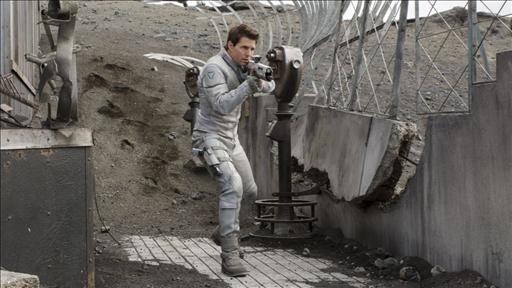
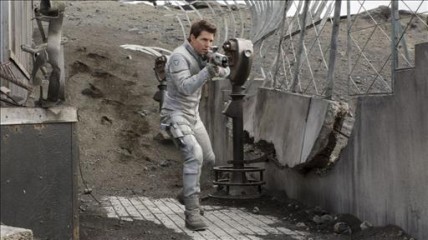

Joseph Kosinki’s sci-fi pretender Oblivion arrives at our cinemas with an unmistakably bulky baggage. It piles up an excessive weight of borrowing, conscious or unintentional, bearing the absolute misfortune of being compared to a live-action version of Pixar’s dystopian romantic sci-fiWALL-E, featuring a protagonist, operating as a mechanic/repairman, roams a desecrated post-apocalyptic Earth where humans have buggered off to a different planet somewhere (this time, one of Jupiter’s moons Titan, of all places). And if that poor, unfortunate comparison isn’t enough to hurt its potential, Oblivion rips DNA strands from the godfathers of the genre – 2001: A Space Odyssey, Blade Runner, The Matrix, War of the Worlds, Total Recall and the recent Sam Rockwell one-man-show cult favourite Moon. Because it’s no longer fucking easy to come up with anything new in 2013 without having to suffer the looming shadow of these genre monoliths. Science-fiction films today either get a congratulatory handshake for trying or endure an ass-whipping for stealing from other superior movies. Hence Hollywood abandoning creative originality and sticking to remakes instead.
So well done to Oblivion for trying. To a degree of surprise, it’s not as insufferable as other few sci-fi releases of recent memory (I see you, John Carter) or as mildly irritating as any Will Smith vehicle. Kosinki has managed to establish a mystery sci-fi picture that’s intriguing and often beautiful to look at – vast, desolate landscapes courtesy of the Icelandic tourist board, capably scored to almost bombastic breadth by French electro-meisters M83 – and placed Tom Cruise at the heart of this vista with all of Cruise’s signature mechanical aplomb. It achieves what I assume to be the film’s goal – a conventional distraction from you daily life’s routine, teasing a bit of your brain and pleasing some fraction of your retinas – but it can never escape the truth that as soon as Oblivionends, nothing much stayed and you’re left unchanged, unmoved and unenlightened. Tom Cruise lends the film with his passable megawatt star power, Olga Kurylenko suffers a conventional estranged-wife role, Melissa Leo is never more than bits of pixels trapped inside a computer screen and Morgan Freeman is impaired with the Morpheus character in The Matrix. Andrea Riseborough is good though, injecting a much-needed humanity in an otherwise rote role. It says a thing or two about a film where Riseborough plays only a supporting role when you expect the leads to deliver more.
The cinematic equivalent of an Ikea furniture – minimalist in approach, derivative in design yet functional as a whole. It just doesn’t help Oblivion settles for acceptable mediocrity rather than aim for achievable greatness.
