
Looper has a fail-safe aesthetic whereby it is so rich in detail that it will always warrant multiple viewings. What’s more, Rian Johnson has crafted a purely stylish picture that many will be eager to feast their eyes over for years to come.
Johnson is one figure in a new league of directors and visionaries that began with one small yet remarkable film. Much like Duncan Jones with Moon, Nicolas Winding Refn with Pusher and Johnson with Brick, allowing for a small-time director to try their hand at a big blockbuster always serves to impress. Looper is such an impressive feat not only for the change in scale for Johnson but for the narrative crux he delves into. Time travel is a troubling issue to get your mind around and whilst Johnson sometimes fails to judge it with clear precision, he sets up a story perfectly using the idea.
Joseph Gordon-Levitt’s Joe is an assassin unlike any we’ve seen before; he’s killing people sent back from the future and erasing them completely. This sounds relatively straight-forward for a time-bending narrative and for the first half it remains as such. The brilliance of the film lies mostly within the first 45 minutes where the lives of Loopers are explored and we are shown a vibrant and curious landscape. Were it not for a relatively small budget this environment could be detailed zealously but unfortunately we see only snippets of the lawless land that the Loopers and criminals run around in. The desire to see more of how Loopers get into the profession or how the execution is planned can only be found in the first act, and not to the extent you may wish for. Johnson isn’t particularly interested in that aspect and we are given a plot-line relating to Joe’s future self returning to the present, escaping and jeopardising lives and timelines.
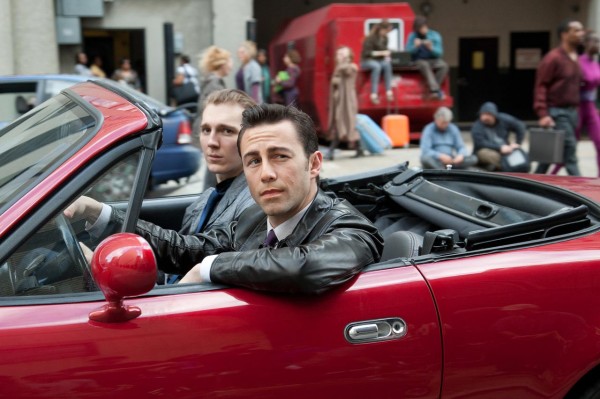
The second act with Willis is tremendous at points and Johnson gives the A-list action-star some terrific scenes but it’s never the Die Hard icon you wish to see, it’s all about Joseph Gordon-Levitt. Although the make-up job to make Gordon-Levitt look like Willis is distracting at points, the performance is bound to be seen as classic. Even with Joe having his scenes stolen by a young Pierce Gagnon at points, the chemistry with the cast and Gordon-Levitt is beyond flawless. The farm house scenes with Gagnon and Emily Blunt are where the film’s humanity really shines through. Giving the film some warmth is needed for a cool thriller and Looper’s mid-section does nothing but award that.
The plot never seems lacklustre but exposition seems somewhat clumsy at points (hints of Joe’s back story may seem obvious to some viewers and thus tawdry). What helps you forget the rough edges is the general look of the film. Steve Yedlin’s mesmerizing cinematography is so beautiful and artistic that it becomes one of the main reasons for the film seeming so fantastic. The aesthetic is quite similar to that of Darius Khondji’s Seven photography or the dazzling displays in Blade Runner or L. A. Confidential. At the heart of Looper’s look is the noir atmosphere (especially the more interesting first half) and the maturity of this approach is so refreshing.
Looper is a smart blockbuster and Gordon-Levitt has noted some the Nolan-esque impetus to have film you both enjoy and pontificate over. The film is accessible and enthralling and certainly leaves you with a lot to think about. There is some visceral violence and intellectual musings about time travel and issues of morality but none of it seems too daunting for a pop-corn movie. One can hope that the film does well at the box-office as would show more people are inviting towards different modes of filmmaking – Johnson is quite unconventional and Looper largely triumphs with his unique take on the time travel genre.